 Save
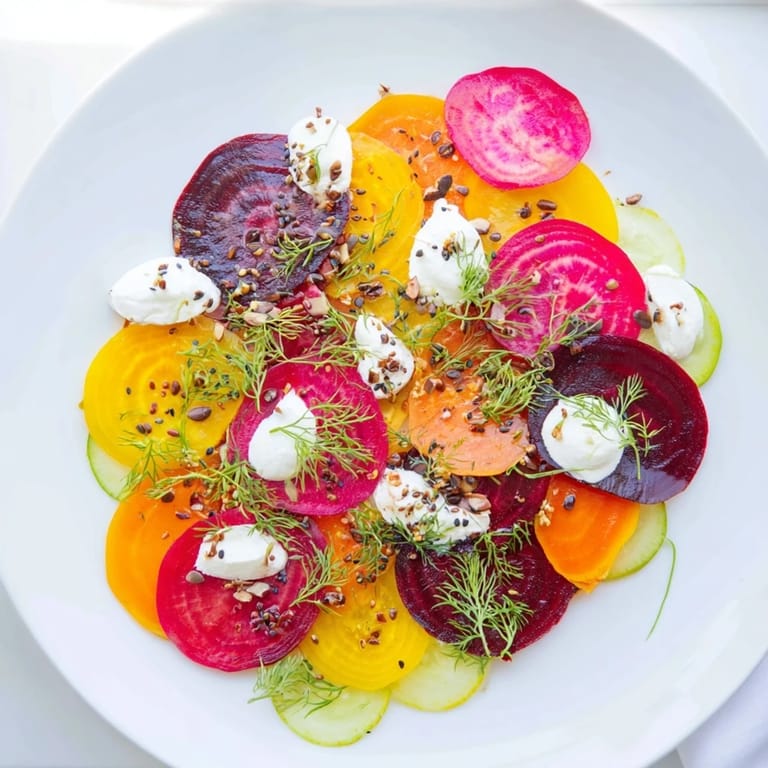
Save I remember the exact moment I fell in love with cooking for the eye as much as the palate. It was at a gallery opening in Copenhagen, where a chef friend had created these impossibly beautiful vegetable arrangements that seemed to dance across white plates. I stood there mesmerized, watching how the colors created this sense of motion even though everything was perfectly still. That night, I went home determined to capture that same feeling in my own kitchen, and this kinetic motion blur dish was born from that inspiration—a love letter to the idea that food can be art in motion.
I made this for my sister's dinner party last spring, and I'll never forget how everyone at the table went completely quiet when I placed the platter down. Not in an awkward way—in that wonderful moment when beauty makes you pause before you dive in. She kept taking photos from different angles, and honestly, that's when I knew this dish had captured something special.
Ingredients
- Golden beet: The sweet, earthy foundation that catches light beautifully when sliced thin—mandoline is your friend here because it creates those paper-thin slices that are almost translucent at the edges
- Red beet: The dramatic counterpart that deepens the color story; wear an apron when slicing or your hands will tell tales for days
- Watermelon radish: The unexpected star—those pale pink rings with white flesh create this natural bullseye that draws the eye exactly where you want it
- Persian cucumber: Gentler and less watery than regular cucumbers, which means cleaner slices and a more delicate flavor that doesn't overpower
- Baby carrots: Sliced on a bias to create those elegant elongated pieces that echo the sense of motion throughout the dish
- Creamy goat cheese: Room temperature is crucial—cold cheese won't dollop beautifully, and it becomes dense rather than creamy
- Toasted hazelnuts: Toast them yourself if possible; the aroma alone tells you when they're perfect, and store-bought toasted nuts sometimes taste like they've been waiting too long
- Black sesame seeds: The visual drama here is undeniable—they add contrast and a subtle nutty whisper to each bite
- Microgreens: These delicate leaves are more about texture and subtle flavor than bulk; they're the final flourish that catches light
- Fresh dill fronds: Just the feathery tops, because the stems can taste bitter and woody; fresh dill has this anise-like brightness that lifts everything
- Extra virgin olive oil: Use one you actually love drinking by the spoonful—it's the dressing's backbone and shouldn't be an afterthought
- Fresh lemon juice: Freshly squeezed only; bottled juice tastes tired compared to the brightness a fresh lemon brings
- Honey: The secret that rounds out the dressing and creates a subtle sweetness that makes people say, "What is that flavor?"
Tired of Takeout? 🥡
Get 10 meals you can make faster than delivery arrives. Seriously.
One email. No spam. Unsubscribe anytime.
Instructions
- Make your dressing first:
- Whisk together the olive oil, lemon juice, honey, salt, and pepper in a small bowl. This takes maybe two minutes, but it's the foundation of everything. Taste it on your finger—it should make you smile, with brightness from the lemon and a gentle sweetness from the honey.
- Create your motion with vegetables:
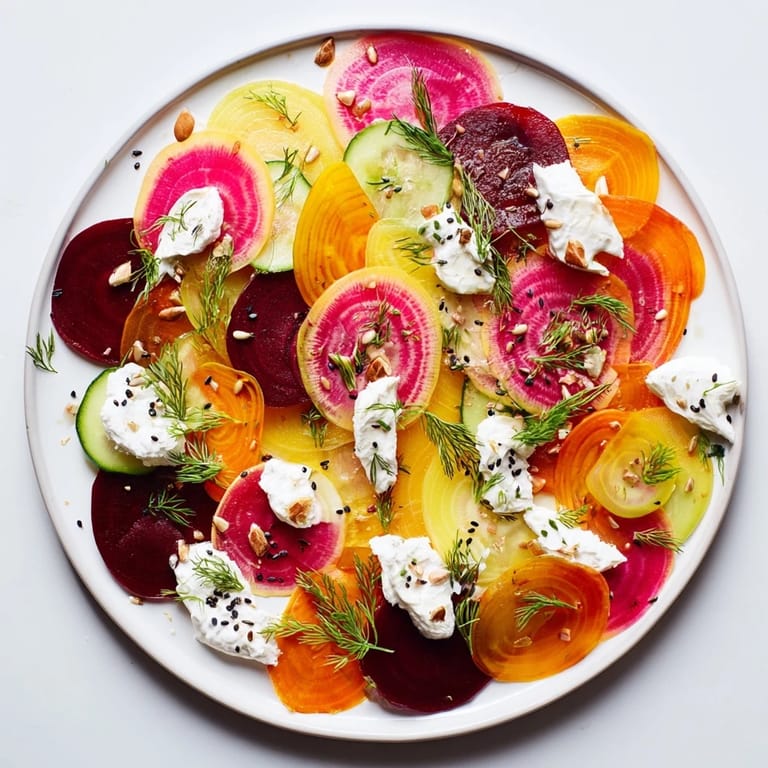
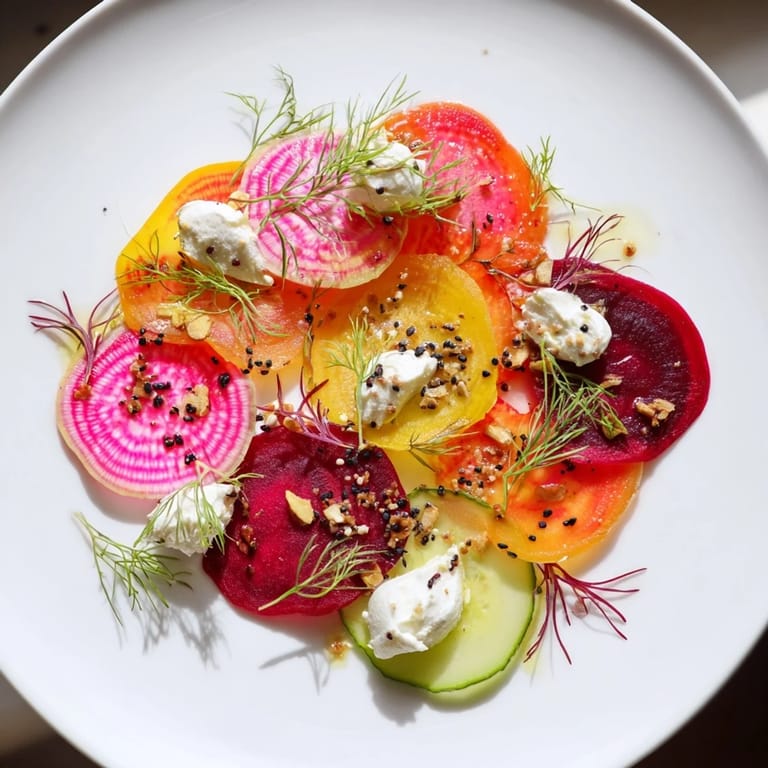
- On your serving platter or individual plates, start building from one side of the plate. Overlap your vegetable slices densely on one half, creating this clustered, almost chaotic energy. Then gradually, as you move across the plate, space them out further and further until they're almost scattered, like they're moving away from their source. This is where the "kinetic blur" magic happens—it genuinely creates a visual sense of motion.
- Dot the goat cheese deliberately:
- Take small dollops of room-temperature goat cheese and place them among the densest vegetable cluster. As you move toward the sparse side, place fewer dollops, eventually trailing off to nothing. These creamy pockets become little flavor surprises throughout the bite.
- Toast then scatter nuts and seeds:
- Sprinkle your toasted hazelnuts and black sesame seeds with intention—more concentrated on the dense side, gradually fading as you move toward the sparse edge. The hazelnuts add a welcome crunch, while the sesame seeds create visual depth.
- Finish with greens and herbs:
- Scatter the microgreens and dill fronds, again following your motion pattern. These delicate leaves should feel like the final movement in a dance—present where needed, absent where the arrangement speaks for itself.
- Dress with intention:
- Drizzle your dressing across the platter with a light hand, using slightly less toward the sparse side to maintain that visual hierarchy you've created. The dressing should enhance, not overwhelm.
- Serve immediately:
- This is not a dish that improves with sitting. The vegetables stay crisp, the microgreens bright, and the visual impact sharp only if you bring it straight from your hands to the table.
 Pin it
 There's a moment after everyone's tasted it when they lean back and say something like, "Wait, this is just vegetables?" And that's when you know you've done it. You've taken humble vegetables and arranged them in a way that makes people think, that makes them look longer, that makes them taste deeper.
The Magic of the Mandoline
Once you own a mandoline, you realize how many dishes you've been underselling with your knife skills. The consistency it creates—where every slice is exactly the same thickness—is what makes this dish work visually. The light catches each slice the same way, creating this unified flow of color and shine. That said, respect the blade like you'd respect a very sharp knife, because it absolutely is one. The guard it comes with might seem clunky, but it's there because fingers and mandolines don't mix well.
Playing With Seasonality
This dish is a canvas for whatever vegetables are at their peak right now. In summer, try thinly sliced zucchini, candy-striped beets if you can find them, and maybe some paper-thin slices of fennel. In fall, add roasted golden beets and different root vegetables. Winter opens doors to celery root sliced thin, parsnips, and even preserved lemon. The structure stays the same—dense to sparse—but the vegetables change with the seasons, so the dish never feels tired even if you make it monthly.
Beyond the Vegetarian Version
If you're not strictly vegetarian, this dish becomes a different kind of beautiful with the addition of smoked salmon or trout draped delicately over the vegetables. The smoke and salt of the fish adds another dimension entirely. I've also made it with prosciutto di Parma sliced gossamer-thin, and the way the flavors interact—nutty ham, bright dressing, earthy beets—creates something restaurant-worthy. Even a few slivers of good aged Parmesan create an entirely different but equally stunning experience. The beauty of this dish is that it welcomes addition as much as it celebrates simplicity.
- If adding fish, place it in the denser section where it acts as an anchor for the whole composition
- Toast a few extra seeds or nuts if adding protein to keep the crunch-to-creamy ratio balanced
- Consider a white wine vinegar in your dressing instead of just lemon if you're going the fish route—the extra acid cuts through the richness
 Pin it
 This dish taught me that sometimes the most elegant food isn't about complexity or technique—it's about seeing what's already beautiful and arranging it in a way that makes others see it too. Every time you make it, you'll find new ways to play with the arrangement, and that's exactly the point.
Frequently Asked Questions
- → What vegetables are used in the kinetic motion blur dish?
The dish features thinly sliced golden and red beets, watermelon radish, Persian cucumber, and baby carrots sliced on a bias.
- → How is the kinetic blur effect achieved in plating?
Slices are densely layered on one side and gradually spaced out to the other, creating a sense of motion and visual flow.
- → What role do the goat cheese and nuts play in this dish?
Goat cheese adds creamy richness, while toasted hazelnuts and black sesame seeds contribute crunch and depth in texture.
- → What kind of dressing complements this arrangement?
A light dressing of olive oil, lemon juice, honey, salt, and pepper is drizzled unevenly to enhance the plating dynamics.
- → Can this preparation accommodate dietary preferences?
Yes, the cheese can be substituted with plant-based alternatives for vegans, and smoked fish options suit pescatarian diets.